

Code of Points 2026
Cyr Wheel
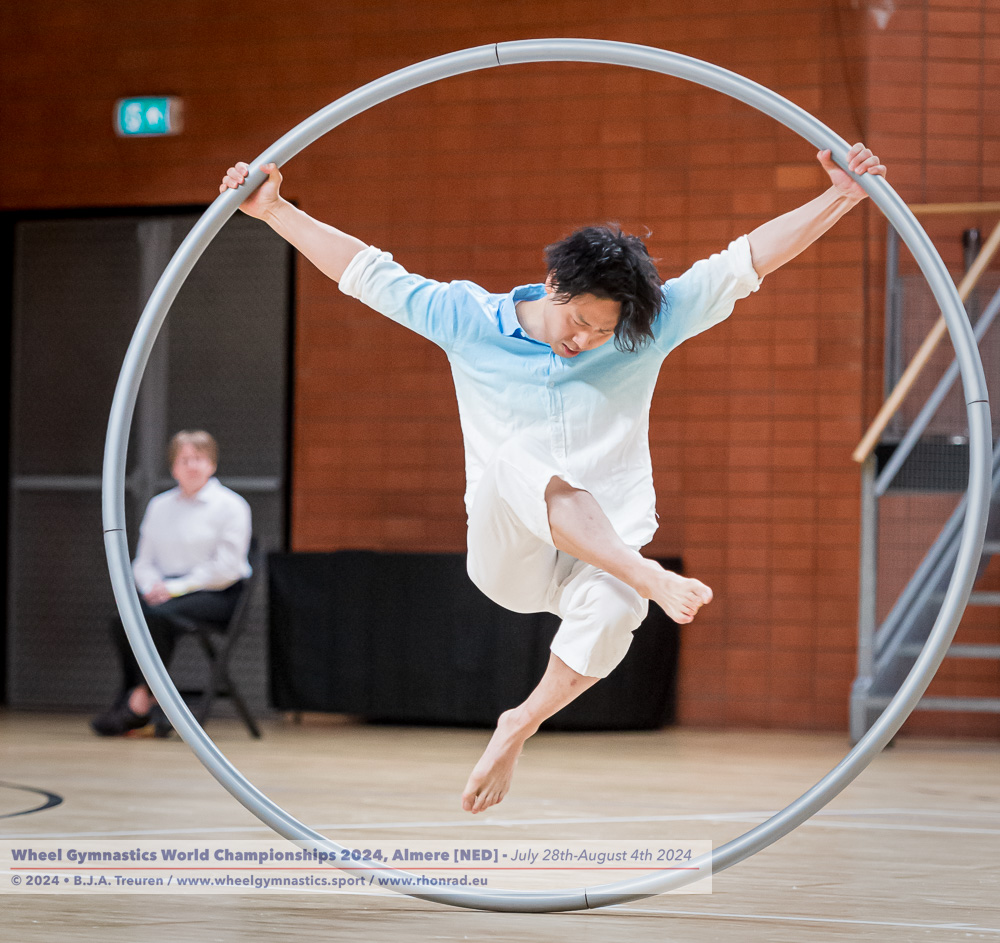
Current Regulations
Artistic Programme
IRV CYR WHEEL Artistic Programme Regulations Version 4.3
published September 2025
[Previous Versions 4.2 (April 2024); 4.1a (January 2022); 4.1 (December 2019)]Technical Programme
IRV CYR WHEEL Technical Programme Regulations Version 4.3
published September 2025
[Previous Versions 4.2 (April 2024); 4.1a (January 2022); 4.1 (December 2019)]Difficulty Catalogue
Cyr Wheel ONLINE Difficulty Database Version 4.3.2
published February 2026
Please use the online database to access all Cyr Wheel Skills, almost all of which are supplemented by videos.
A printable pdf version of the catalogue can be generated using the printing feature in the online database.
Submission of New Skills
If you want to submit a new skill, please use the submission feature in the online database for this purpose.
Submission deadline: 31 December each year
General comments on Artistic and Technical Programme Regulations 2026:
- Unified scoring maximum of 20 points for Artistic and Technical Programmes
- Elimination of execution judges in the Artistic Programme – streamlined judging panels
- Flexibility in routines: no minimum length; maximum duration remains 3 minutes 15 seconds
- Greater artistic freedom with transitions, music choice, and choreography
- Judges who would like to receive training on the new regulations can schedule an appointment with us
For questions or clarifications, please contact: mhanisch@wheelgymnastics.sport (Melanie) or hnarten@wheelgymnastics.sport (Hauke)
Discussion Summary (April 2026)
A series of online judging discussion sessions were held in April 2026. A summary of the discussions from these sessions can be found below:
Status: Discussion notes only.
Important: No final decisions or rule changes were made in this session. The following points were identified as topics that should be clarified, corrected, re-worded, or reviewed in future updates of the regulations, difficulty catalogue, videos, and/or judges’ briefing material.
Reference documents:
The discussion referred to the IRV Cyr Wheel Code of Points consisting of the following:
- IRV Cyr Wheel Artistic Programme Regulations v4.3
- IRV Cyr Wheel Technical Programme Regulations v4.3
- IRV Cyr Wheel Difficulty Catalogue v4.3.2.
1. General points for future clarification in artistic impression
The artistic regulations include the evaluation criteria for artistic impression, where there is an instruction to “Use a margin of ±0.5 points to reward or penalize the connection between the gymnast and the wheel, especially when the gymnast performs outside the wheel” as part of evaluating a gymnast’s “Dedication to convey an artistic message”. Several wording issues were identified where the current regulations or catalogue descriptions may lead to different interpretations by gymnasts, coaches, and judges. These points should be reviewed for future correction or clarification. Unclear terminology should be made more precise, especially where the recognition of difficulty depends on exact movement quality, body position, number of repetitions, or the allowed movement between two parts of an element.
Translation issues were also mentioned. Future translations should preferably be handled or checked through the national federations or an agreed official process, so that differences between language versions do not create interpretation problems.
The question was raised whether places on the competition floor are fixed for Spiral, Cyr, and Gym Wheel at the upcoming World Championships in Göttingen, especially because seats or positions may already be numbered and therefore may not be freely exchangeable. This requires organizational clarification.
2. Technical Programme – transitions and recognition rules
A general point was raised that spins and changes should be clearly declared as permitted transitions, where applicable. The current technical regulations already list transitions consisting of basic step/waltz skills, coin spins, turns/twists, and spirals, and state that transitions have no difficulty value of their own. However, the discussion showed that the wording may still need to be clearer for practical judging situations.
For the turn/twist category, the current wording says that T skills must either be repeated at least twice in succession or performed as a combination with no basic step in between by default. It also allows limited basic steps between certain half turns/twists and full turns/twists. This rule should be reviewed together with the difficult catalogue wording, because the group discussed possible contradictions or misunderstandings regarding repetition, combinations, and identical elements.
The following point should be clarified in a future judges’ meeting: Within a turn/twist combination, repetition of the same element is currently not intended to be treated in the same way as a valid combination of different elements. At the same time, identical elements may still be recognized under the separate rule “performed twice in succession.” This distinction should be explained more clearly.
3. Artistic Programme – artistic impression wording
The wording of “Dedication to convey an artistic message” was discussed. The current artistic regulations include the instruction to use a margin of ±0.5 points to reward or penalize the connection between the gymnast and the wheel, especially when the gymnast performs outside the wheel.
The group noted that this wording may need improvement. The aim should be to make clearer how judges should apply this margin, without changing the intended evaluation principle during the discussion.
4. Definition of splits [ German: Spagat ]
The definition of a split position [ German: Spagat ] was discussed as an unclear area.
Open points for future clarification:
- What exact body angle is required for recognition?
- How much angular deviation is acceptable?
- Must the knees be fully extended?
- How should borderline cases be judged?
- Should different types of splits, side splits, and split-like positions be defined separately?
No final definition was agreed. A more precise catalogue or regulation definition is recommended for a future update.
5. Communication with judges
The question was raised whether a score can be questioned by a gymnast or coach. This should be clarified procedurally in the future, ideally in competition rules or judges’ briefing material. As for Gym Wheel, the only score that should be open for discussion is the difficulty score.
6. Specific elements and catalogue issues discussed
BS-C 3
The recognition of BS-C 3 was discussed, especially the requirement involving 360° within four changes of direction. The note from the discussion was that recognition should be considered when the 360° requirement is fulfilled. The exact wording should be checked and clarified in the catalogue.
Direction changes / switch with hands
The group discussed direction changes involving the hands. The English description should be treated as decisive, but the wording should be checked to avoid translation-based misunderstandings.
BS-C 10 Backward roll / [ German: Rolle rückwärts ]
It was unclear what exactly counts as the “skill” in this context and whether two big spirals may be performed in between. This should be clarified in the element description.
The question was raised whether two backward rolls with a cartwheel in between can be treated as a valid sequence or whether the cartwheel counts as a transition or intervening skill.
The backward roll wording was considered unclear. Open questions include:
- May another skill be performed in between?
- Is the movement between parts considered a skill or a change?
- How can the difficulty be achieved if the element must now be shown twice?
- Does the current text need to be adapted?
No decision was made. A new video could improve clarification.
BS-C 11 “Banana”
A video should be submitted later for review. The same applies to the additional video mentioned by Cyrus (USA).
Back coin spin with one leg / rond de jambe
The group discussed why Lea’s (Spain) element was not recognized. The answer was that there was no acceleration visible to allow for recognition as an E element.
Spin A-6
A correct video should be submitted. It was also discussed whether the element might fit better as a B spin, possibly in a straight position / [German: Querverhalten]. This remains open for review.
Continuous half turn without hands
There was a request for a clear indication of whether this element will be recognized or not. No final answer was made during the session; it remains an open clarification point.
It was clarified that a free 180° rotation must be clearly shown. If the hip is pre-rotated before the movement, the element must also finish in this same hip position. If there is an element in between which allows grabbing with the hand, then the second turn/twist must also be shown 180° free.
7. CS preamble / starting and ending positions
The preamble for CS elements was discussed, especially whether the requirement for standing position should be removed or adjusted.
The group noted that it should be possible to move from one position into another, where appropriate. The wording should be reviewed so that valid transitions into and out of CS positions are not unintentionally excluded.
8. T-D 1a/b wording
The wording of T-D 1a/b was discussed. It should be checked whether the current text suggests that the element must be performed directly in succession or whether touching/regripping in between is allowed.
A possible contradiction with the preamble was mentioned, because one place appears to allow contact in between while another may imply direct succession. This should be clarified.
9. Full hanging turn
The group discussed whether the full hanging turn only has to be shown once. It was noted that the relevant sentence was moved to the structure group, but the rule should still count. This should be checked and clarified in the final wording.
T-C 4 – continuous one-armed half turns
It was discussed that the safest option for recognition is to perform the element exactly as described in the current catalogue text: “continuous one-armed half turns on trailing leg” and the video represents continuous one-armed half turns without grabbing in between. But the foreword said that it could be made. The agreement is that a full free half turn has to be shown twice.
10. Element Combination
Is has to be checked weather a static or dynamic skill is part of the element combination. Static elements only has to be shown once (like foreword) dynamic elements has to be shown like they are described (e.g. Monkey jumps – continuously as repetition at least 3 times)
11. Pocket cards and the use of higher-valued elements
Can a higher-valued element be shown as a lower-valued element for the purpose of showing variation?
The discussion note was that an element may only be used once on the pocket card. It was also noted that if the element already exists in the catalogue, it should not simply be used as a different lower-valued element. If the exact element does not exist in the catalogue, the situation may need separate treatment. This point should be formally clarified later and not treated as a final decision from this session.
12. Cyr Wheel Battle
Two organizational questions were raised for the Cyr Wheel Battle:
- When will it be decided who judges the battle?[The IRV will choose the judges for the Battle.]
- What backgrounds or qualifications should the battle judges have?
Judging Criteria for the Battle
Each judge scores in three categories:
1. Technique & Difficulty
- Variety and risk (difficulty of tricks and transitions)
- Control, balance, and precision
- Quality and cleanliness of execution
2. Musicality and Use of Music
- Connection between movement and sound
- Timing and synchronization with musical cues, accents, tempi
- Ability to react spontaneously to unknown music
3. Artistry, Originality & Presence
- Personal style and creativity
- Use of interaction with the wheel
- Stage presence and connection to the audience
- Overall composition and flow of the run(s)
In case of questions, please contact: mhanisch@wheelgymnastics.sport (Melanie)